
IE-102 A Process Outlook for Industrial Engineering
Prof. Nesim Erkip
2013-2014- Spring
The main objective of the course is to familiarize the IE freshmen with the profession by introducing the basic notion of process. Industrial engineers visualize any systems as a collection of physical and abstract things, each of which are described by a process and these interrelated processes become crucial in the way system functions. Topics related to design of processes and process improvement, as well as notions of performance evaluation are covered and relations to decision making concepts are outlined. Throughout the course simple examples from daily life, as well as more complex examples from the service and manufacturing industries are used.
 | Lecture 34 (2014-05-15) Wrap-up: Video: Definition of IE, Methodology of IE, IE Curriculum at Bilkent University. Study recommendation: Bilkent IE WEB page, Comments on Exam 2, Lecture Notes Keywords to remember: All keywords considered previously | |
 | Lecture 33 (2014-05-14) Wrap-up: Video: Big Bang Theory – Definition of IE, Methodology of IE, IE Curriculum at Bilkent University. Study recommendation: Bilkent IE WEB page, Comments on Exam 2, Lecture Notes Keywords to remember: All keywords considered previously | |
 | Lecture 32 (2014-05-07) Mathematical modeling example: Linear Programming Keywords to remember: “decision variable”, “performance measure”, “objective function”, “constraint”, “mapping descriptions into symbols – mathematical modeling – formulating the problem”, “feasible region”, “characterization of an optimal solution: corner point – extreme point” | |
 | Lecture 31 (2014-05-07) Mathematical modeling example: Linear Programming Keywords to remember: “decision variable”, “performance measure”, “objective function”, “constraint”, “mapping descriptions into symbols – mathematical modeling – formulating the problem”, “feasible region”, “characterization of an optimal solution: corner point – extreme point” | |
 | Lecture 30 (2014-04-24) Simulation, probabilities. Keywords to remember: “developing models for randomness”, “simulation”, “statistics”, “simulation model – representation of reality”, “simulation is an evaluative model”, “probability”, “probability mass function(pmf)”, “expected value” | |
 | Lecture 29 (2014-04-11) Queuing Theory: Under this title, we will analyze waiting lines Keywords to remember: “randomness”, “arrivals”, “service”, “traffic intensity”, “expected number in the system”, “expected waiting time”, “exponential distribution”, “Little’s Law” | |
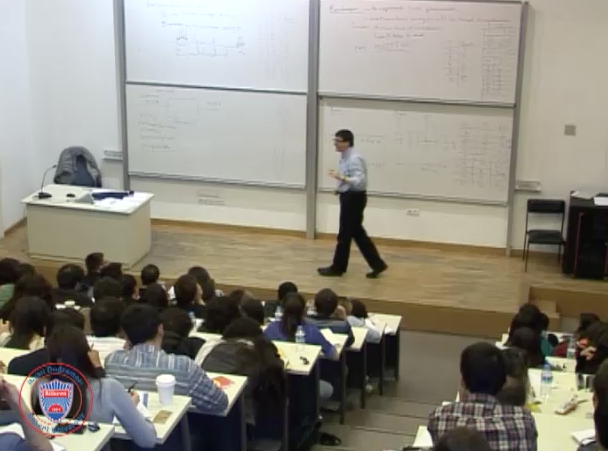 | Lecture 28 (2014-04-09) Queuing Theory: Under this title, we will analyze waiting lines Keywords to remember: “randomness”, “arrivals”, “service”, “traffic intensity”, “expected number in the system”, “expected waiting time”, “exponential distribution”, “Little’s Law” | |
 | Lecture 27 (2014-04-09) Queuing Theory: Under this title, we will analyze waiting lines Keywords to remember: “randomness”, “arrivals”, “service”, “traffic intensity”, “expected number in the system”, “expected waiting time”, “exponential distribution”, “Little’s Law” | |
 | Lecture 26 (2014-04-03) Systems Thinking: Definitions and examples Keywords to remember: “critical thinking”, “activities of critical thinking” “rational judgments”, “decision process”, “mathematical representation”, “mathematical representation”, “systems thinking”. | |
 | Lecture 25 (2014-04-03) Systems Thinking: Definitions and examples Keywords to remember: “critical thinking”, “activities of critical thinking” “rational judgments”, “decision process”, “mathematical representation”, “mathematical representation”, “systems thinking”. | |
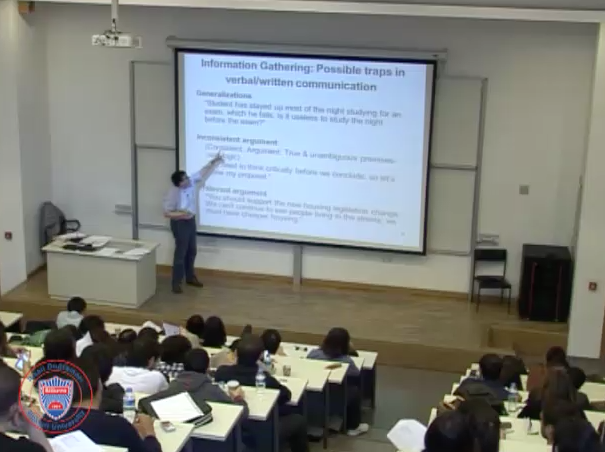 | Lecture 24 (2014-04-02) Critical Thinking: Definition; activities of critical thinking; issues in information gathering; examples Keywords to remember: “critical thinking”, “activities of critical thinking” “Verbal mapping”, “information source”, “traps (irrelevant argument, false analogy, etc.)” | |
 | Lecture 23 (2014-04-02) Critical Thinking: Definition; activities of critical thinking; issues in information gathering; examples Keywords to remember: “critical thinking”, “activities of critical thinking” “Verbal mapping”, “information source”, “traps (irrelevant argument, false analogy, etc.)” | |
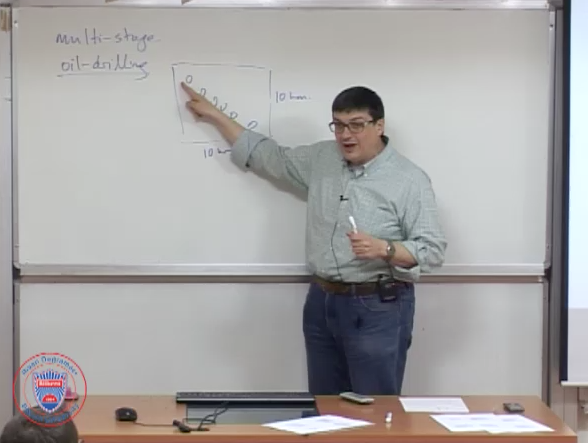 | Lecture 22 (2014-03-27) Decision Trees Keywords to remember: “decision trees”, “chance node”, "multi-stage decisions" | |
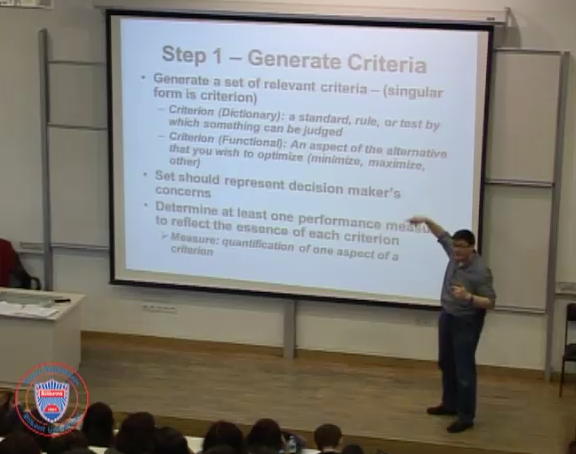 | Lecture 21 (2014-03-26) A Framework for decision making under multiple criteria Keywords to remember: “Set of Alternatives”, “a set of criteria (same as set of measure or a composite measure)”, “scaling”, “data collection”, rescaling”, “weighing – assigning relative importance”, “decision process”, “cost/time trade-off in measuring” | |
 | Lecture 20 (2014-03-26) A Framework for decision making under multiple criteria Keywords to remember: “Set of Alternatives”, “a set of criteria (same as set of measure or a composite measure)”, “scaling”, “data collection”, rescaling”, “weighing – assigning relative importance”, “decision process”, “cost/time trade-off in measuring”. | |
 | Lecture 19 (2014-03-20) Definition of "decision"; relation to performance measure. Example case Keywords to remember: “Performance Measure”, “decision”, “decision-maker”, “problem owner” | |
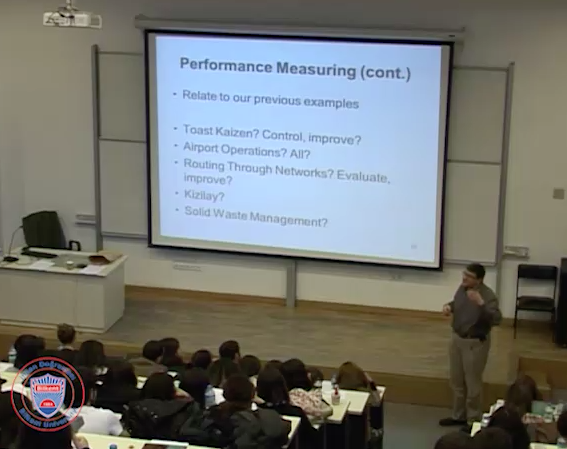 | Lecture 18 (2014-03-19) Performance Measure and How to Measure. Keywords to remember: “Performance Measure”, “effectiveness measures”, “efficiency measures”, “motivation for measuring performance”, types of measurement”, “how to measure”, “hierarchy of measures” | |
 | Lecture 17 (2014-03-19) Wrap-up: Networks Keywords to remember: “Performance Measure”, “effectiveness measures”, “efficiency measures”, “motivation for measuring performance”, types of measurement”, “how to measure”, “hierarchy of measures” | |
 | Lecture 16 (2014-03-13) A Manufacturing System - Assignment Problem Keywords to remember: “optimization”, “lower bound”, “structural properties” | |
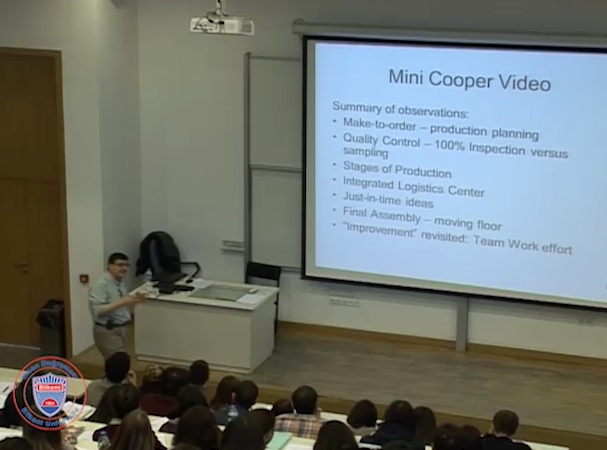 | Lecture 15 (2014-03-12) A Manufacturing System Keywords to remember: “schedule”, “layout”, “make-to-order”, “assembly”, “quality control”, “teamwork”, “logistics” | |
 | Lecture 14 (2014-03-12) A Manufacturing System - Video: Inisde a Factory Keywords to remember: "schedule", "layout", make-to-order", "assembly", "quality control", "teamwork", "logistics" | |
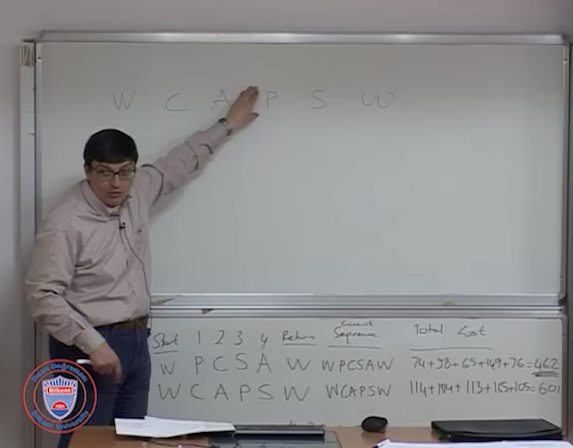 | Lecture 13 (2014-02-27) Traveling Salesman Problem Study recommendation: Read C&E pp. 13-24, lecture notes Keywords to remember: “optimization”, “computational order of an algorithm”, “NP Hard”, “heuristics | |
 | Lecture 12 (2014-02-27) Traveling Salesman Problem Study recommendation: Read C&E pp. 13-24, lecture notes. Keywords to remember: “optimization”, “computational order of an algorithm”, “NP Hard”, “heuristics" | |
 | Lecture 11 (2014-02-26) Networks – Shortest Path Problem Study recommendation: Read “A Solution Method: Routing Through Networks: Read Chelst and Edwards (C&E) pp. 1-12”, and lecture notes. Keywords to remember: “network representation”, “algorithm” | |
 | Lecture 10 (2014-02-26) Networks – Shortest Path Problem Study recommendation: Read “A Solution Method: Routing Through Networks: Read Chelst and Edwards (C&E) pp. 1-12”, and lecture notes. Keywords to remember: “network representation”, “algorithm” | |
 | Lecture 9 (2014-02-20) Charts and diagrams; objectives; Flow Diagrams. Discussion | |
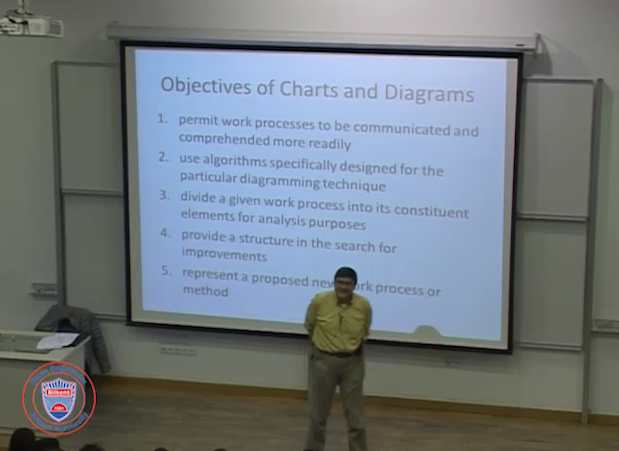 | Lecture 8 (2014-02-19) Charts and diagrams; objectives; Gantt Chart, Operation Chart, Process Charts Examples. | |
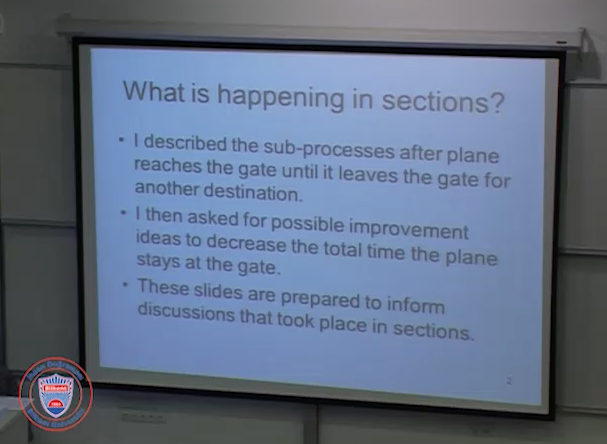 | Lecture 7 (2014-02-19) Go over the improvement ideas discussed in sections. Re-emphasize the key-words of the previous week. | |
 | Lecture 6 (2014-02-13) How to use process knowledge to "solve" IE problems? Keywords to remember: “performance measure”, “mathematical modeling”, “complex situations”, “improvement”, “trade-off” | |
 | Lecture 5 (2014-02-13) How to use process knowledge to "solve" IE problems? Keywords to remember: “performance measure”, “mathematical modeling”, “complex situations”, “improvement”, “trade-off” | |
 | Lecture 4 (2014-02-12) Wrap-up previous week + Process examples: Service Systems. For each of the clips, observe the processes involved: 1) To understand operations considered; 2) To find out their relation; 3) To conceptualize possible related performance measures; 4) To propose ideas for improvement. Observation is a very useful complementary tool for understanding operations, the relations, and finally to initiate critical analysis for improvement. | |
 | Lecture 3 (2014-02-12) Wrap-up previous week + Process examples: Service Systems. For each of the clips, observe the processes involved: 1) To understand operations considered; 2) To find out their relation; 3) To conceptualize possible related performance measures; 4) To propose ideas for improvement. Observation is a very useful complementary tool for understanding operations, the relations, and finally to initiate critical analysis for improvement. | |
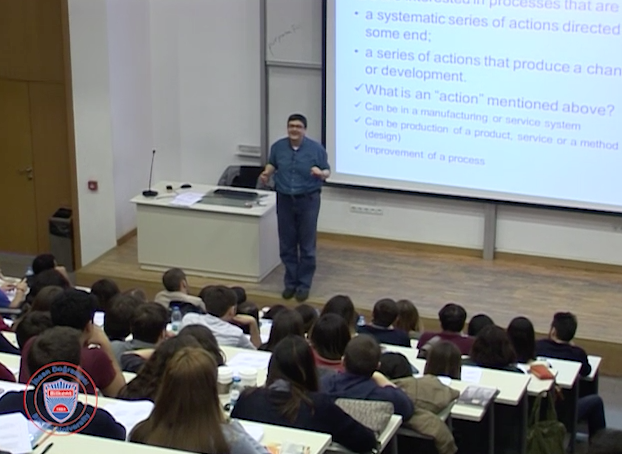 | Lecture 2 (2014-02-05) Introduction: Course Information. Definition of the word “Process”. Study recommendation: Read lecture notes, comments on Quiz 1 (when available). Keywords to remember: “Process”, “engineering”, “engineered process”, “decisions embedded into processes”. | |
 | Lecture 1 (2014-02-05) Introduction: Course Information. Definition of the word “Process”. Study recommendation: Read lecture notes, comments on Quiz 1 (when available). Keywords to remember: “Process”, “engineering”, “engineered process”, “decisions embedded into processes”. |